The solution of the Helmholtz equation
As we have seen in the previous lecture, the Helmholtz equation describes the propagation of the electric field in an anisotropic medium. In particular, this equation describes field propagation in free space between two planes of an optical system. The solution of the Helmholtz equation in free space can be found using a plane-wave decomposition, which leads to the Rayleigh–Sommerfeld diffraction integral for scalar fields. This integral allows us to calculate the field at any point in space given the field distribution on a plane, which is essential for understanding how light propagates through optical systems and diffracts around obstacles.
Green’s function
The Green’s function allows us to solve the differential equation with a source term:
where is a linear differential operator, is the unknown function we want to find, and is a known source term. The Green’s function, denoted as , is defined as the solution to the equation
where is the Dirac delta function, which represents a point source located at . The Green’s function can be used to express the solution to the original equation as an integral:
Physically, the Green’s function represents the response of the system to a point source, and the integral sums the contributions from all sources in the volume to find the total solution at point .
Weyl representation of spherical waves
The Weyl representation of spherical waves is a mathematical technique used to express spherical-wave solutions of the Helmholtz equation in terms of plane waves. This representation is particularly useful for explaining the propagation of light in free space using the Rayleigh–Sommerfeld diffraction integral, which will be discussed below.
The spherical wave is given by the expression:
where is the wavenumber and is the distance from the source. The spherical wave is the solution of the Helmholtz equation in free space with a point source described by the Dirac delta function. It is possible to decompose the spherical wave into a superposition of plane waves:
where
is the Fourier transform of the spherical wave.
The wave equation for the point source can be written as
Substituting the plane-wave decomposition into this equation, we can derive the expression for the 3D Fourier transform of the spherical wave. Applying the Laplace operator in the Fourier domain, we get
where is the square of the magnitude of the wavevector.
Substituting this expression into the wave equation, we obtain
Next, using the representation of the Dirac delta function as an integral of plane waves, we can express the right-hand side as
and substitute it into the equation to get
Equating the integrands on both sides of the equation, we find the expression for the Fourier transform of the spherical wave:
In order to obtain the 2D Fourier transform of the spherical wave, we can integrate the 3D Fourier transform over the component:
Assuming that for waves propagating in the positive direction and denoting , we can rewrite the integral as
We can observe that the integrand has two simple poles at . To evaluate the integral, we use a regularization technique by introducing a small imaginary part to the poles. The sign of the imaginary part is determined by the condition that the wave should decay as (the Rayleigh–Sommerfeld condition). Therefore, we can write as with . Substituting this into the integral gives the poles
As and , the pole at is located in the upper half of the complex plane, while the pole at is located in the lower half of the complex plane. To evaluate the integral, we can close the contour in the upper half-plane and apply the Cauchy residue theorem. Thus, the integral can be evaluated as
Substituting back , we obtain the Weyl representation of the spherical wave:
or
where and are the transverse components of the wavevector and position vector, respectively.
Rayleigh–Sommerfeld diffraction integral
The Rayleigh–Sommerfeld diffraction integral is a mathematical expression that describes the propagation of light in free space, particularly how it diffracts around obstacles. It is an exact solution of the Helmholtz equation in free space and can be derived using a plane-wave decomposition. Thus, the general scalar equation describing field propagation in free space can be written as
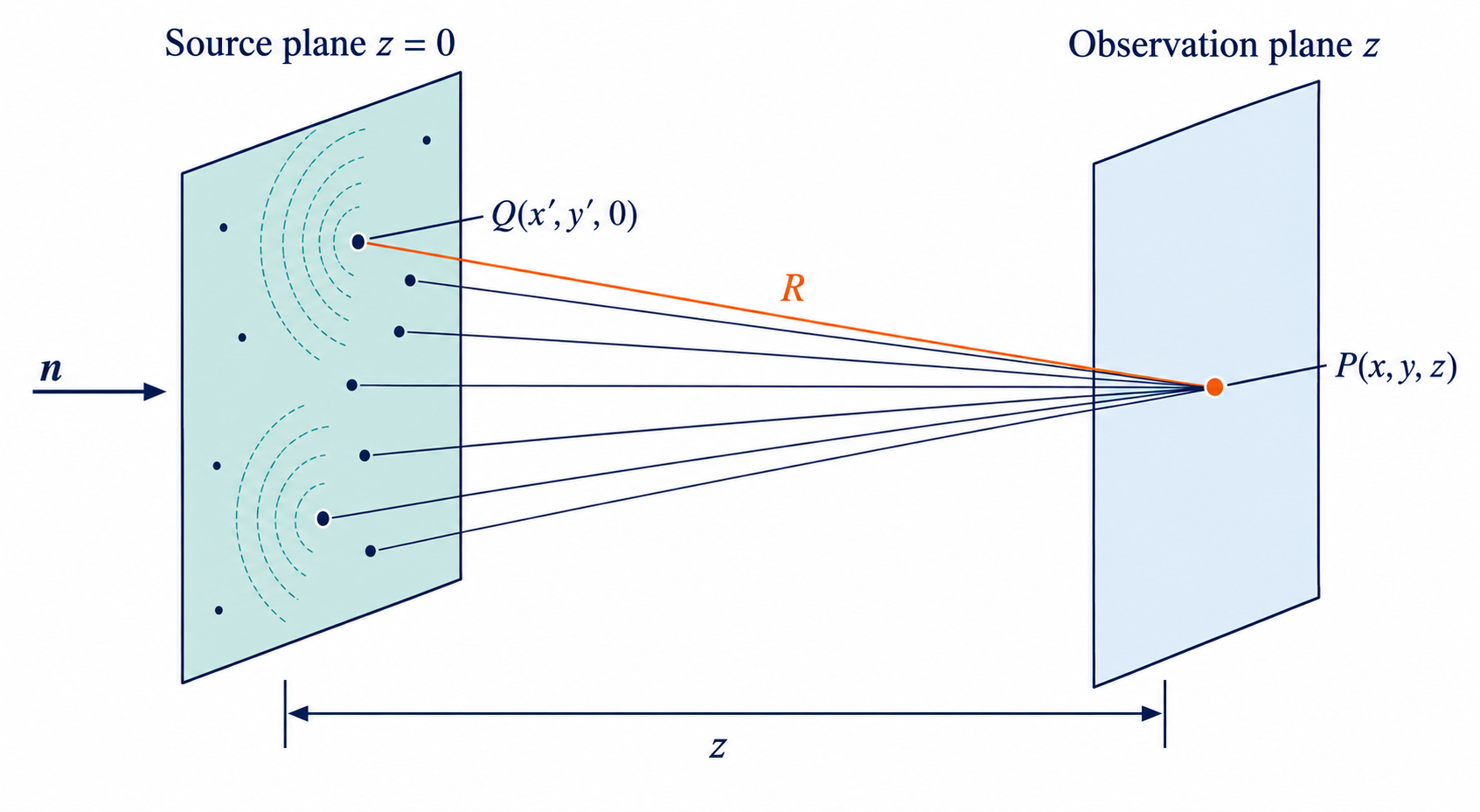
Every source point contributes a spherical wave to the field at the observation point ; is the distance between the two points.
where . The two-dimensional plane-wave decomposition of the field is given by
where and are the transverse components of the wavevector and position vector, respectively.
Substituting this equation into the Helmholtz equation, we get
Denoting , we can write the solution of this equation in the spatial-frequency domain as
The choice of functions and is determined by the boundary conditions of the problem.
First, the Fourier transform of the field at gives the relation
Second, the Rayleigh–Sommerfeld condition states that the wave should decay as , which implies that . Therefore, we can express the solution of the Helmholtz equation in the spatial-frequency domain as
An important point is that the expression under the square root in can be negative, which corresponds to evanescent waves that decay exponentially with distance. It is preferable to include these evanescent waves in the solution to ensure its completeness, especially when dealing with near-field effects or when the field distribution at contains high spatial frequencies.
Next, we apply the inverse Fourier transform to obtain the solution in the spatial domain:
Notice that
Thus,
Finally, the solution of the Helmholtz equation in the spatial-frequency domain can be expressed as the Rayleigh–Sommerfeld diffraction integral using the convolution theorem:
where is the field distribution at and the convolution is performed in the transverse coordinates, . This integral describes how the field propagates from the plane at to any point in space , taking into account both the amplitude and phase changes due to diffraction. The physical interpretation of this integral is that the field at any point in space can be considered as a superposition of contributions from all points on the plane at , where each contribution is weighted by the modified spherical wave
Longitudinal component of the field
In the previous sections, we have focused on the transverse components of the field, which are typically dominant in many optical systems. However, the longitudinal component of the field can also play a significant role, especially in tightly focused beams or near-field optics. The longitudinal component arises along the optical axis of the system (usually denoted by ) due to the vector nature of the electromagnetic field and can be derived from the transverse components using the divergence-free condition of the electric field in free space:
The Rayleigh–Sommerfeld diffraction integral can be expressed in terms of a partial derivative with respect to as follows:
where is the field distribution at , is the distance from the source point to the observation point , and .
Thus,
Taking into account that
we can express the longitudinal component of the field as
The component of the field is usually ignored in many problems due to its small magnitude compared with the transverse components, i.e., and are much smaller than . This regime is called the paraxial approximation.
References
- Kedar Khare, Fourier Optics and Computational Imaging, Wiley, 2015.
- Joseph W. Goodman, Introduction to Fourier Optics, 4th ed., W. H. Freeman, 2017.
- Max Born and Emil Wolf, Principles of Optics, 7th expanded ed., Cambridge University Press, 1999.